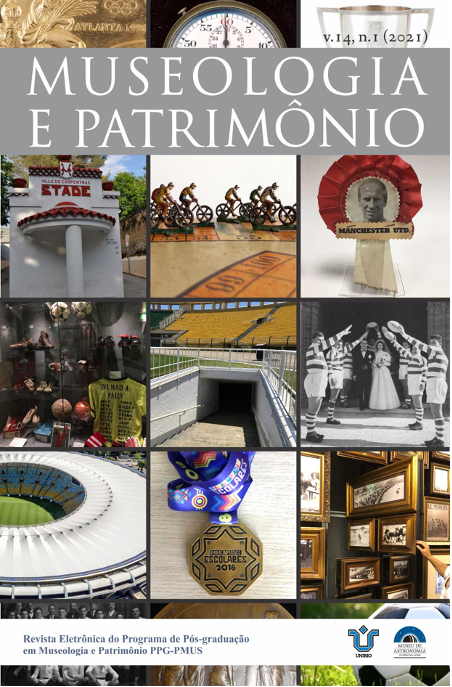
Sports Tourism and Cultural Heritage: The Football Museum in Brazil as a thematic attraction

Authors

  • Filipe Soares Romano
  • Ricardo Ricci Uvinha

Keywords:

turismo esportivo, patrimônio cultural, estádios de futebol, Museu do Futebol, cidade de São Paulo.

Abstract

Football is an integral part of the culture and history of Brazil. Taking into account the international characteristic of being the “country of football”, tourism took advantage of this symbolic element to propose spaces and equipment built around this theme. Sports Tourism, a segment where discussions involving the approximation between tourism and football are inserted, can be characterized by three different types: Sports Practice Tourism; Sports Event Tourism; and Nostalgia Tourism. The latter, Nostalgia, includes tourists from stadiums, arenas or sports museums motivated by the knowledge of new cultures, realities, meanings and structures. The aim of this study is to analyze the reports released by OS ID Brasil that manages the Football Museum in the city of São Paulo and correlate it with the theoretical framework on Sports Tourism, offering subsidies for the discussion of these spaces. It is intended to address them not only as cultural heritage, but also as tourist attractions in their potential for the creation of public policies and the promotion of sports tourism. The research is of a descriptive character, having as methodological procedures the bibliographic and documentary analyzes related to the tourist activities of sport and leisure (products, demands, services, attractions, routes and itineraries).

Downloads

Download data is not yet available.

Published

2024-10-14

How to Cite

Romano, F. S., & Uvinha, R. R. (2024). Sports Tourism and Cultural Heritage: The Football Museum in Brazil as a thematic attraction. Museologia E Patrimônio, 14(1), 182–211. Retrieved from https://revistamuseologiaepatrimonio.mast.br/index.php/ppgpmus/article/view/867

Issue

Section

Dossiê
                                                                  ADOConnection.CacheExecute(3600, SELECT 				o.submission_id, 				MAX(s.context_id) AS journal_id, 				MAX(i.date_published) AS i_pub, 				MAX(p.date_published) A..., Array[2]) % line  132, file: DAO.inc.php
                                                               DAO.retrieveCached(SELECT 				o.submission_id, 				MAX(s.context_id) AS journal_id, 				MAX(i.date_published) AS i_pub, 				MAX(p.date_published) A..., Array[2], 3600) % line   91, file: ArticleSearchDAO.inc.php
                                                            ArticleSearchDAO.getPhraseResults(Object:Journal, Array[1], null, null, , 500, 1) % line  202, file: SubmissionSearch.inc.php
                                                         SubmissionSearch._getMergedPhraseResults(Object:Journal, Array[1], , null, null, 500, 1) % line  147, file: SubmissionSearch.inc.php
                                                      SubmissionSearch._getMergedKeywordResults(Object:Journal, Array[4], , null, null, 500, 1) % line  195, file: SubmissionSearch.inc.php
                                                   SubmissionSearch._getMergedPhraseResults(Object:Journal, Array[4], null, null, null, 500, 1) % line  147, file: SubmissionSearch.inc.php
                                                SubmissionSearch._getMergedKeywordResults(Object:Journal, Array[3], null, null, null, 500, 1) % line  133, file: SubmissionSearch.inc.php
                                             SubmissionSearch._getMergedArray(Object:Journal, Array[1], null, null) % line  264, file: SubmissionSearch.inc.php
                                          SubmissionSearch.retrieveResults(Object:Request, Object:Journal, Array[1], null, null, null, Object:DBResultRange, Array[1]) % line   92, file: RecommendBySimilarityPlugin.inc.php
                                       RecommendBySimilarityPlugin.callbackTemplateArticlePageFooter(Templates::Article::Footer::PageFooter, Array[3]) % line  107, file: HookRegistry.inc.php
                                    HookRegistry.call(Templates::Article::Footer::PageFooter, Array[3]) % line 1256, file: PKPTemplateManager.inc.php
                                 PKPTemplateManager.smartyCallHook(Array[1], Object:Smarty_Internal_Template) % line   43, file: 42362804174f266c598cdb32c3208fc745b92101^1c372c95cd85572e0fbc9a53d0323a0b229cfc78_0.app.frontendpagesarticle.tpl.php
                              content_69b5fe7f070617_92440466(Object:Smarty_Internal_Template) % line  123, file: smarty_template_resource_base.php
                           Smarty_Template_Resource_Base.getRenderedTemplateCode(Object:Smarty_Internal_Template) % line  114, file: smarty_template_compiled.php
                        Smarty_Template_Compiled.render(Object:Smarty_Internal_Template) % line  216, file: smarty_internal_template.php
                     Smarty_Internal_Template.render(false, 1) % line  232, file: smarty_internal_templatebase.php
                  Smarty_Internal_TemplateBase._execute(Object:Smarty_Internal_Template, null, 42362804174f266c598cdb32c3208fc745b92101, null, 1) % line  134, file: smarty_internal_templatebase.php
               Smarty_Internal_TemplateBase.display(frontend/pages/article.tpl, null, 42362804174f266c598cdb32c3208fc745b92101, null) % line  924, file: PKPTemplateManager.inc.php
            PKPTemplateManager.display(frontend/pages/article.tpl) % line  292, file: ArticleHandler.inc.php
         ArticleHandler.view(Array[1], Object:Request) % line  391, file: PKPRouter.inc.php
      PKPRouter._authorizeInitializeAndCallRequest(Array[2], Object:Request, Array[1], false) % line  231, file: PKPPageRouter.inc.php
   PKPPageRouter.route(Object:Request) % line  143, file: Dispatcher.inc.php
Dispatcher.dispatch(Object:Request) % line  281, file: PKPApplication.inc.php
PKPApplication.execute() % line   68, file: index.php